
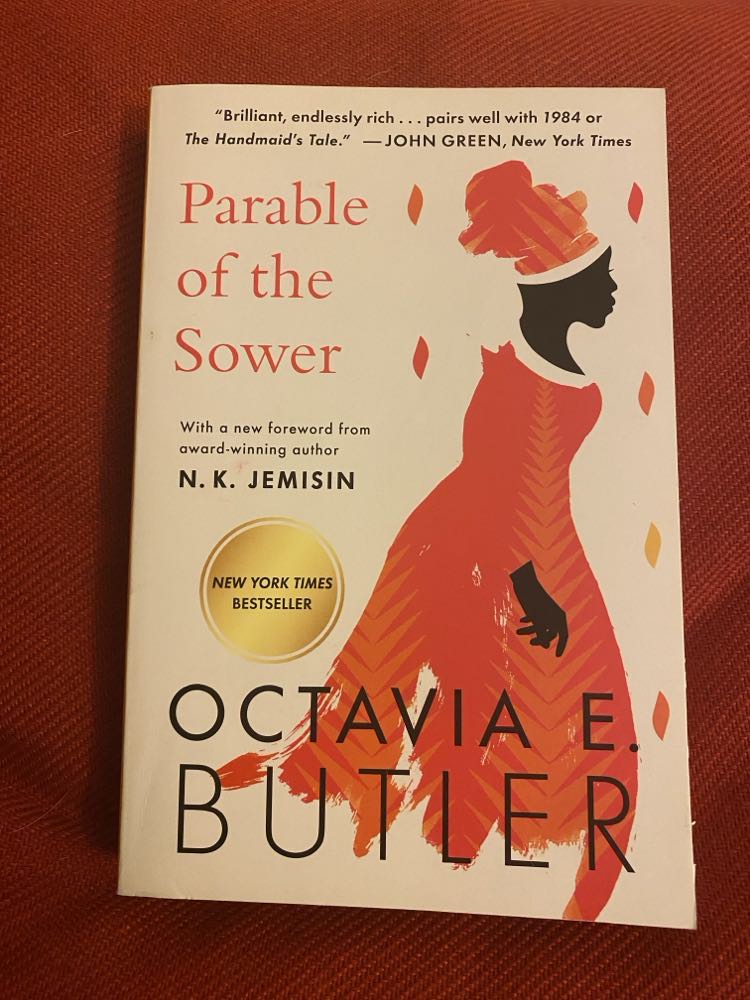

This is my SPOILER-FREE Book Review for
Parable of the Sower by Octavia Butler
I intend to use the ***ASPECT method for my discussion and will not spoil the ending.
This review is available in podcast form over on The Pages and Popcorn Podcast
Purchase your own copy of this book and support the blog by clicking here!
Ok, in case you have never heard of Parable of the Sower, here is a bit of information.
The book is set in a post-apocalyptic Earth heavily affected by climate change and social inequality. The novel follows Lauren Olamina, a young woman who can feel the pain of others as she becomes displaced from her home and sets out on a quest. Several characters from various walks of life join her on her journey north and learn of a religion she has envisioned and titled Earthseed. The main tenets of Earthseed are that “God is Change” and believers can “shape God” through conscious effort to influence the changes around them. Earthseed also teaches that it is humanity’s destiny to inhabit other planets and spread the “seeds” of the Earth.
Parable of the Sower has won multiple awards, including the 1994 New York Times Notable Book of the Year, and it has been adapted into both an opera and a graphic novel. Parable of the Sower has influenced music as well as essays on social justice and climate change. In 2021, it was picked by readers of the New York Times as the top science fiction nomination for the best book of the last 125 years.
Parable of the Sower is the first in an unfinished series of novels, followed by Parable of the Talents in 1998. More on that later.
Let’s start with the promo blurb
This acclaimed post-apocalyptic novel of hope and terror from an award-winning author “pairs well with 1984 or The Handmaid’s Tale”
When global climate change and economic crises lead to social chaos in the early 2020s, California becomes full of dangers, from pervasive water shortage to masses of vagabonds who will do anything to live to see another day. Fifteen-year-old Lauren Olamina lives inside a gated community with her preacher father, family, and neighbors, sheltered from the surrounding anarchy. In a society where any vulnerability is a risk, she suffers from hyperempathy, a debilitating sensitivity to others’ emotions.
Amazon
Let’s get into it!

Again, I will be using my ASPECT method, but I reserve the right to go out of order in terms of the ASPECT acronym.
For example, I am going to just jump right in with the why THIS book.
T: Why This Book?
Well ok, I got the smart idea to relaunch this podcast in December of 2024. You know, December, a month of multiple gatherings and events and holidays, and to-do lists that go onto the 2nd or third pages… So, in order to keep to my little self-imposed schedule, I thought I would cheat for this first episode and do a review of a book that I already sort of reviewed back in 2021. Sorry to those of you who already heard me talk about this book.
But honestly, I could have picked any older book or review and I picked this one because I read it in January 2021. I read this book days after the January 6th insurrection, you know the day when Trump and his minions tried to take control of our government and permanently changed American politics, for the worse. And… well, I think as it is now January 2025, and Trump and his minions are about to actually take control of our government, it seemed like an appropriate time to revisit this book and its subject matter.
Originally I read this book because during covid my book club did more themed picks or author picks and Octavia Butler was the author we had picked to focus on… and I had read and enjoyed Kindred but had never read Parable of the Sower even though I had heard it was her best or at least the one she is the most famous for.
The T in ASPECT can sometimes stand for TYPE as in What TYPE of book is it… and like I already said, this book is considered speculative fiction. If you plan on listening to more of my reviews, get used to that term.
Speculative fiction covers a wide variety of genres including but not limited to, fantasy, sci-fi, urban fantasy, high fantasy, dystopian, time travel, body swapping, and robots…. It is basically anything that isn’t actually possible or part of our current shared reality. In other more dictionary words: the setting is other than the real world, involving supernatural, futuristic, or other imagined elements. So… Handmaid’s Tale, 1984, sure… but also things like Back to the Future, The Magicians, or even that new Netflix romcom Hot Frosty… I mean, a snowman comes to life, that’s magic. Speculative fiction is insanely broad as a category and I personally read a fair amount of it.
A Atmosphere:
The book takes place in the early/mid 2020s… 2024-2027. The “future” it paints is… horribly not all that implausible. It is weird to read books set in “the future” that is actually “the now” because you cannot help but compare, to see the differences, and to be horrified by the overlaps. Interesting to note, Butler wrote this book in the early 1990s. She was writing only thirty years into her own future which is a pretty bold move considering how she described it.
ALSO worth noting… This book came out in 1993, and in 1995 the two part Deep Space Nine episode Past Tense came out and it has sooo much overlap that I am willing to bet a rabbit that the writers over at DS9 read this book and were influenced by it. Both take place in 2024, both have the walls, and the abhorrent poverty…. Both have people fighting back… both have the government / police that do nothing…
I mean, DS9’s ep was optimistic with the benefit of this being a time-traveling episode where we know that *eventually* things worked out for the humans…. Eventually… Butler’s look at the future is far more pessimistic, far more brutal, far more hard to live in for a while… but the parallels are interesting.
The atmosphere and the tone of this book is dark. The world is dark… but it is never unbelievable. That is what makes it so scary. We believe every word that Lauren, our protagonist, tells us. More on Lauren in a second, but before we move away from atmosphere… again, I say that this book is so presciant and believable that it is difficult to get through.
The book is about a horrible horrible world and the horrors never stop. In the hands of a less skilled writer, you could get desensitized to what is happening. So many murders. So many rapes. So many children being killed. But somehow Butler keeps us feeling those feelings without ever going numb, as much as we might wish we could.
C Characters:
Butler’s writing, especially her writing of our main character Lauren, is really layered. There are a lot of things going on both in the world around Lauren and in Lauren’s mind that even Lauren isn’t fully aware of, but that we as readers know… and then there are the things that Lauren decides to not tell us. This is a complicated character who walks a very, very fine line between being competent and a Mary Sue. And honestly, I think she strays over that line a few times. She is the only one who really sees the danger? She is the only one who has done XYZ? She is… gifted but also like, touched by the God she doesn’t believe in. What keeps her away from annoying Mary Sue-ness, I think, is that she is a prophet and she legit has a weird supernatural ability that does her more harm than good. Also, she thankfully surrounds herself with helpers and is humble enough to learn from others. She doesn’t see herself as the Chosen One even if she acts like it. And let’s be clear, she is creating a religion out of the chaos of her world, and as someone with a healthy dose of skepticism for any religious leader, I sometimes found her hard to understand. Which… I think is okay. I am curious if her “specialness” continues to fuel her and if she becomes the thing she mistrusts… Was Butler planning on writing a series where Lauren would evolve into something that early Lauren would not have liked? Does power corrupt? Sadly, Butler only wrote one more book in this “trilogy” before she died. And… honestly, I probably won’t read it because I know that the trilogy was unfinished.
S Style:
We are reading Lauren’s journal so a lot of times we get action scenes backhanded. The entry will open up with “we survived the attack” and then we get the story of the attack etc. This works fine… but sometimes it made it hard to get the adrenaline pumping during a scene that should have had us on the edge of our seats.
And… is Lauren a reliable narrator? Sure. Mostly. But we are limited to her experiences and her perception of those experiences. And… ok… I know she is the special gifted person… but sometimes I had trouble really buying that her voice was authentic. When I found myself bumping on her words though I would just remind myself that she is a supernatural being who is the founder of a religion in a world where people have supernatural abilities… it is hard to quibble over what parts of the fantasy are hard to believe when you remember that this is speculative fiction, not just dystopian fiction.
As for any other note about Butler’s writing style. Well… I feel like Lauren’s voice was mighty similar to Dana’s voice from Kindred. Maybe that’s just Butler’s voice coming through and it isn’t necessarily a bad thing. But, there you have it.
P Plot:
It’s a bit long and I think it might have benefited from having a shorter/quicker start. The story really picks up after Lauren is forced to flee her neighborhood. Until then, it was a lot of set up and exposition but it was very clear that everyone, even the characters, were waiting for something to happen, waiting for the story to really start. I could have seen this story working really well if the “before the exodus” bit had been told in flashbacks on the journey. But the story itself was interesting enough to keep me reading.
E Entertaining:
Yes. It was clearly setting up a longer story, and so there were some aspects that went past “slow burn” and into “those coals are only kinda warm” territory for me.
And yet… I cared a lot about what was happening. I wanted to know what was going to happen next, and I was downright worried for several of the characters. So, yes. It was entertaining.
Would I recommend it?
Probably. I think I liked Kindred better. But Kindred was also self-contained and this book is clearly setting up its sequels, which, again Butler didn’t get to finish. But yes, this is a really interesting book full of interesting and frightening warnings about the future, and I am glad I read it. I also really like speculative fiction, I don’t need everything explained to me if the world-building is done well enough that my lingering questions are not plot-related, and this book fits that bill superbly. If for no other reason, the fact that even without the supernatural religion part (which might have been my least favorite part) this book serves as a pretty scary warning about climate change and that is something that I know we need to take seriously. Handmaid’s Tale warned us about religious zealots and some of the possible ways that patriarchy and religion can really screw everyone over… this book makes a compelling case that climate change is the real danger out there… and yet by placing us in Lauren’s head, a protagonist who has grown up in that world, we as readers don’t have to watch the beginning of the fall of society (which would be a bummer for sure) but rather we get to watch the beginnings of the part of the grand social story where people start to make things better. Going back to Star Trek for a second, this book is less like the equivalent of the Bell Riots in some ways and more like First Contact because we get to see Zephryn build his ship, we are seeing the beginning of the next chapter in humanity and we already know that it ends up excelling and reaching the stars. Parable of the Sower is not as optimistic, but it is clearly trying to be.
I will give the caveat that Parable was intended to be book 1 in a trilogy and like many trilogies the first one can stand alone and leaves you wanting but not needing more… and the second one, well, I am pretty sure it will end on a cliff hanger (again, trilogy rules) but since Butler died tragically before she could write the third and final book… you have to know that there will never really be a resolution. This book can function alone, but if you are like me, you might never want to read the next one knowing that you will never get the whole story.
Ok, to wrap up, it was actually kind of a good read in January 2021, it offered a bit of hope when we were trying to find things to be optimistic about. And, to be honest, it would probably be a great book to read in this January as we are facing down 4 more years of whatever Trump and Elon Musk are going to do. Should we start a new religion? Well, maybe not. But maybe we should hug our families and find reasons to laugh with our friends because at least we aren’t living in walled neighborhoods, rationing our water, and running from packs of evil-doers. At least not yet.
Thanks for reading!
A Atmosphere: How did it make me feel? What was the world like? This might include the overall tone.
S Style: What was the writing style like? Simplistic or sophisticated? Clunky or beautiful?
P Plot/Pace: Was it engaging? Were there holes? Did it feel too rushed or too long?
E Enjoyment: Was it a chore to finish or compelling enough that I picked it over other fun activities?
C Characters: Were they believable, sympathetic, interesting?
T This? Why did I read *This* book? What “Type” of book is it?


Leave a Reply